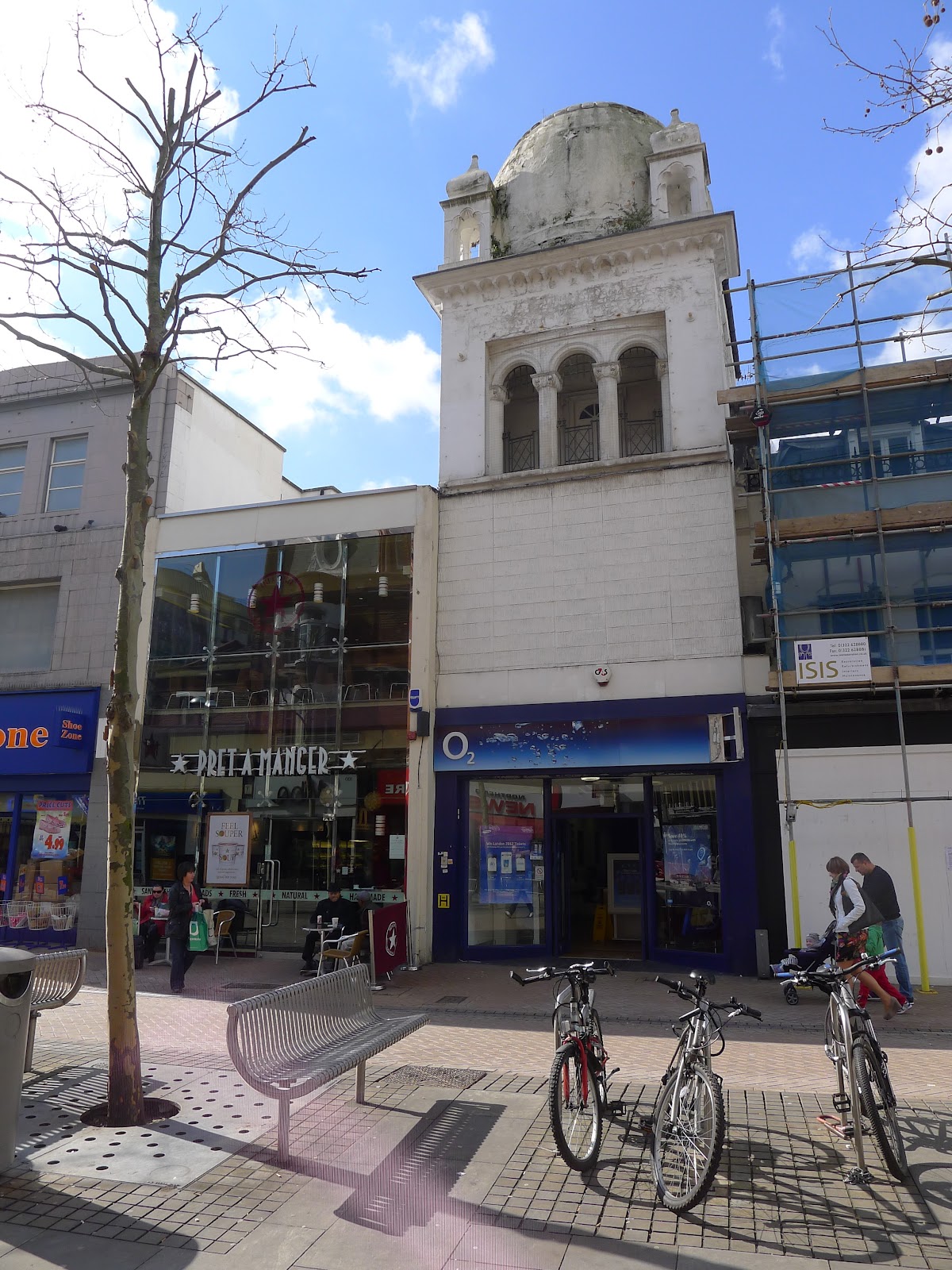
Unlike the weather over the last couple of weeks a month ago saw the blissful reemergence of the sun for a brief period, and with this effect came football in the park, intermittent bbq's and for myself a fresh observation of Croydon's urban layering and another subject to write about. It is strange what specific aspects of architecture are suddenly made obvious simply because they become draped in sunlight.
Allow me to set the scene, and a very familiar scene at that.
Walking through Croydon's high street and even down the smaller side streets, which arguably hold the most interesting shops and ventures to be found, you are visually bombarded by the various fonts, images and colours of the shop signs and window displays. This deliberate marketing technique which tries ever so desperately to gain your attention through high contrast and visual noise generates an incredible distraction for the brain, usually resulting in a lack of interest in the happenings above the longitude of the shop signs. Yet above this level is an equally sized area of rich historical context most likely a result of modern business having little to no interest in the goings on at this level, which is actually great news for anyone infused with architecture.
There are many small architectural wonders to be found at this level and unfortunately I do not have time to go through them all and in a way I would not want to either as this action would most likely take the fun out of the discovery itself not just for me but for everyone else. Nevertheless, one section of the High Street deserves individual discussion because of its unique past function and contrast in age and aesthetics to its immediate context. A small section of the Prince's Picture House, an old cinema built in 1921, still sits curiously above the current O2 phone shop boasting its arabic-esque appearance amongst the many contemporary glass-facades of neighbouring buildings, such as that of Pret A Manger. All you have to do is look above the shop signage and immediately you notice the transition of both material and form into a completely different building, in fact on a good day if you open your imagination and block the lower section of your vision with your hand to leave only the arches and onion dome of the tower, you could be anywhere in the world. Although this piece of architecture is obviously copying a form and order that is usually implicated at a far grander scale and lavishness it is still a rare and beautiful thing to have right in the middle of a commercial district in Western Europe.
What is most amusing about these architectural remnants such as the Prince's Picture House is that in the current age we live in it appears we have a longing for this reach back into history, to combine the contemporary with all the warmth of the past, yet quite often it is all right up there already for the taking if we just looked upwards. As it stands however there is a literal and physical line drawn between the functions of today and the character of yesterday, almost everything from shop signage downwards is simply about attraction and profit whilst the upper floors, whatever their appearance may be, is usually considered in physical volume alone. In Croydon there exists a great amount of interesting architecture above street level especially around the Old Town area, but I am not suggesting a complete re-habitation of these elements, just a wider realisation and understanding of its existence to better influence development of the town.
tW
Documentation and description of Croydon's architectural gems. Observing the town through Surrey Street Market to local pubs. There is so much to see in this rather large town in South London and so much of it is undocumented or only found in tired historical books mainly concerned with churches and terraced housing. Hopefully this blog can reveal some of the fascinating urbanities I have discovered in Croydon. tW
Tuesday, 8 May 2012
Friday, 27 April 2012
Beneath the Concrete Beast
Venturing around and between the heights and subways of Croydon you can find many vibrant social spaces where you can do almost anything from enjoying the simple pleasure of a warm cup of coffee to playing a game of chess, yet there are some spaces that are so dramatic in scale they seem to blur into the surrounding urban landscape. Quite often these spaces do not appear to play a leading role in our everyday lives simply because their functions are not as pronounced as their counterparts, but performing what is without question a humble role these spaces are both important and beautiful.
Surprisingly, car parks are frequently good examples of such spaces and the Wandle Road Car park located underneath the Croydon Flyover is Croydon's very own. Drive to this space, park your car in this space and make your way into Croydon like most people and chances are you will not notice the enormous environment that is actually surrounding you. However, go during the middle of the day when the cars sit static like a multi-coloured metallic carpet and you can really appreciate the full majesty of the space that exists here. Simultaneously carrying vehicles above and sheltering them below, to perform the former function that is essentially suspending an entire section of road off the ground takes a considerable amount of engineering and material, and what you end up with is a huge raw concrete roof elevated by equally huge concrete columns at visually satisfying regular intervals. Yet to be in this space is to be swallowed up by the mass and shadows that the form presents and in a strange way this in itself creates a comforting feeling like the security of an older brother.
Whilst I happened to be in the belly of the car park I made sure to do the usual architecture student stuff such as kicking surfaces and shouting for echoes to both test the merit of the structure and reinforce the usefulness of my education, the ticket warden stared intently probably through fear more than curiosity but I ignored him and continued my sensual assault on the structure. This soon lead me to conclude that although functioning rather successfully as a car park there is surely a better use for such a large and dramatic space, and if the the town is to rid its parenting of the term 'Croydonisation' then redefining spaces such as the Wandle road Car park as urban social and/or cultural spaces may very well be a positive starting point.
An outdoor cinema/theatre, brewery, open-air restaurant or even a space for car-boot sales, this space would become so much more excitable and useful if it held one of these functions instead of just being car storage, a place of abandonment. Although thinking about it a park would be a fantastic addition in this dense urban area, providing a link between urban Croydon and the greenery of Duppas Hill, with the height of the flyover allowing more than enough light to pass underneath this relatively quiet area located away from the hustle and bustle of the High Street could really benefit from such a refashioning. There is no reason why a rigid concrete car park cannot become a fresh green space or exciting temporary cinema in the summer months, all that is required is the belief and the understanding that these changes may just improve our experience of the town we live in. So when the time is right I applaud you to go stand in the strange comfort of this car park beneath the concrete beast, and join me in quietly imagining an alternative future.
tW
Whilst I happened to be in the belly of the car park I made sure to do the usual architecture student stuff such as kicking surfaces and shouting for echoes to both test the merit of the structure and reinforce the usefulness of my education, the ticket warden stared intently probably through fear more than curiosity but I ignored him and continued my sensual assault on the structure. This soon lead me to conclude that although functioning rather successfully as a car park there is surely a better use for such a large and dramatic space, and if the the town is to rid its parenting of the term 'Croydonisation' then redefining spaces such as the Wandle road Car park as urban social and/or cultural spaces may very well be a positive starting point.
An outdoor cinema/theatre, brewery, open-air restaurant or even a space for car-boot sales, this space would become so much more excitable and useful if it held one of these functions instead of just being car storage, a place of abandonment. Although thinking about it a park would be a fantastic addition in this dense urban area, providing a link between urban Croydon and the greenery of Duppas Hill, with the height of the flyover allowing more than enough light to pass underneath this relatively quiet area located away from the hustle and bustle of the High Street could really benefit from such a refashioning. There is no reason why a rigid concrete car park cannot become a fresh green space or exciting temporary cinema in the summer months, all that is required is the belief and the understanding that these changes may just improve our experience of the town we live in. So when the time is right I applaud you to go stand in the strange comfort of this car park beneath the concrete beast, and join me in quietly imagining an alternative future.
tW
Friday, 20 April 2012
YOURCODENAMEIS:IYLO
If you happen to glance over the platforms at West Croydon station you will notice a piece of fairly contemporary architecture, discarded by modern economics and politics, a relic of its own time, the IYLO building.
Cemented in the company of the residential void between Croydon and Selhurst in the middle of what is essentially a roundabout this hollow concrete shell of a structure nestles quietly among the columns of terraced housing that permeate outwards in all directions. Having asked a few people about the building in general I was informed by a friend that the developers funding the IYLO project had begun construction, laying the foundations and erecting almost the entire core concrete structure only to find themselves bankrupt and unable to commit to finishing the project, leaving the architecture veiled by an incomplete glass curtain wall that gives an immense ghostly presence over the surrounding area.
In a move away from other high-rise residential developments in Croydon at the time IYLO was located away from the area around East Croydon, which consists of existing buildings with functions and aesthetics like that of the IYLO, choosing instead a plot of vacant land further north along Wellesley Rd amongst houses and schools. As with the majority of modern developments of this scale the ground floor was essentially outlined for retail purposes, coffee shops and delicatessens presumably to fuel the anticipated upper-middle class residents, with the floors vertically beyond that assigned to a high-rise style of living. The basic principals enforced to create this style of development are solid, discover land not being utilised, build upwards to make full use of the space and maintain community connection at ground level by use of public space and commercial property. But it just seems too simple, too text book even? This urban formula, if it can be called that, can be applied to any style of development anywhere in the UK and this is where the idea falls short. The local context and environment needs to be considered in far greater detail than is often the case, and the fact that more housing is required and precedent exists for the programme model does not simply mean this solution can, and should be applied ubiquitously.
Now the lifeless grey mass of a structure that slouches sadly against the Wellesley Rd today, and which has done so for long over a year now, acts a message to the local community and more importantly the community of Croydon that at the heart of many of these 'modern' developments is a method and scale of construction that is outdated and damaging. That said, I do hope that the IYLO project is eventually adopted and completed in the near future as its continued existence as a skeleton of a building will only damage the urban grain further. Lessons can and have to be learnt from the mistakes made at the IYLO project, especially mistakes that would have been forgotten had the project not been cut short like it was. Should we not at least consider the restoration and improvement of neglected existing housing stock, structurally sound and already integrated into the urban grain, rather than continually venturing into bold new plans?
tW
Cemented in the company of the residential void between Croydon and Selhurst in the middle of what is essentially a roundabout this hollow concrete shell of a structure nestles quietly among the columns of terraced housing that permeate outwards in all directions. Having asked a few people about the building in general I was informed by a friend that the developers funding the IYLO project had begun construction, laying the foundations and erecting almost the entire core concrete structure only to find themselves bankrupt and unable to commit to finishing the project, leaving the architecture veiled by an incomplete glass curtain wall that gives an immense ghostly presence over the surrounding area.
In a move away from other high-rise residential developments in Croydon at the time IYLO was located away from the area around East Croydon, which consists of existing buildings with functions and aesthetics like that of the IYLO, choosing instead a plot of vacant land further north along Wellesley Rd amongst houses and schools. As with the majority of modern developments of this scale the ground floor was essentially outlined for retail purposes, coffee shops and delicatessens presumably to fuel the anticipated upper-middle class residents, with the floors vertically beyond that assigned to a high-rise style of living. The basic principals enforced to create this style of development are solid, discover land not being utilised, build upwards to make full use of the space and maintain community connection at ground level by use of public space and commercial property. But it just seems too simple, too text book even? This urban formula, if it can be called that, can be applied to any style of development anywhere in the UK and this is where the idea falls short. The local context and environment needs to be considered in far greater detail than is often the case, and the fact that more housing is required and precedent exists for the programme model does not simply mean this solution can, and should be applied ubiquitously.
Now the lifeless grey mass of a structure that slouches sadly against the Wellesley Rd today, and which has done so for long over a year now, acts a message to the local community and more importantly the community of Croydon that at the heart of many of these 'modern' developments is a method and scale of construction that is outdated and damaging. That said, I do hope that the IYLO project is eventually adopted and completed in the near future as its continued existence as a skeleton of a building will only damage the urban grain further. Lessons can and have to be learnt from the mistakes made at the IYLO project, especially mistakes that would have been forgotten had the project not been cut short like it was. Should we not at least consider the restoration and improvement of neglected existing housing stock, structurally sound and already integrated into the urban grain, rather than continually venturing into bold new plans?
tW
Thursday, 12 April 2012
By the Warmth of the Refrigerator Light
In this short piece of literature I wish to draw attention to a piece of architecture, not by merit of its outward aesthetic nor of its intriguing form of which it has neither, but because of its functional position it holds within Croydon.
I am of course referring to the Mediterranean Food Centre II, and of course I expect only a small fraction of people to have knowledge of where this social pillar of a business is situated. Allow me to enlighten. As you make your journey through the chaotic flow of Surrey St Market, limbs of colourful stalls and air flaked with mysterious scent one quite often fails to observe the shop fronts hidden behind this temporary daily facade of the market. Only during the evening hours and into the night can one begin to gain an idea of the kind of goings on that operate within these walls.
During the early hours of the night when the majority of Surrey Street's operations are static, like a gentle beacon the artificial refrigerator lights of the Mediterranean Food Centre II reach out onto the tough surface of Surrey St, guiding the people of Croydon to a place to buy that much needed extra packet of rizla or can of redbull. Whilst most of the town has turned its back on the populace of Croydon by this time, leaving the operations of the night to the pub-landlords and bouncers, this small business continues to operate providing the hungry, gasping and tired of some escape. There is no denying that this place is no Guggenheim or Sydney Opera House but the function of the business is solid and many a time I have visited this place between pubs and bus stops, and no matter how many times I continue to visit I can safely say I will never tire from the pleasure of seeing the glow of the Mediterranean Food Centre II sign.
tW
I am of course referring to the Mediterranean Food Centre II, and of course I expect only a small fraction of people to have knowledge of where this social pillar of a business is situated. Allow me to enlighten. As you make your journey through the chaotic flow of Surrey St Market, limbs of colourful stalls and air flaked with mysterious scent one quite often fails to observe the shop fronts hidden behind this temporary daily facade of the market. Only during the evening hours and into the night can one begin to gain an idea of the kind of goings on that operate within these walls.
During the early hours of the night when the majority of Surrey Street's operations are static, like a gentle beacon the artificial refrigerator lights of the Mediterranean Food Centre II reach out onto the tough surface of Surrey St, guiding the people of Croydon to a place to buy that much needed extra packet of rizla or can of redbull. Whilst most of the town has turned its back on the populace of Croydon by this time, leaving the operations of the night to the pub-landlords and bouncers, this small business continues to operate providing the hungry, gasping and tired of some escape. There is no denying that this place is no Guggenheim or Sydney Opera House but the function of the business is solid and many a time I have visited this place between pubs and bus stops, and no matter how many times I continue to visit I can safely say I will never tire from the pleasure of seeing the glow of the Mediterranean Food Centre II sign.
tW
Tuesday, 3 April 2012
Baskets for Hanging
Last Friday, after receiving an email inviting me to public consultation of Croydon's Old Town I found myself in a little known area of town just off of Surrey St Market known as Matthews Yard. A few balloons, flags on string and a selection of large question and answer post-it-note boards indicated I was at the right location, but as is the primary draw back of this space the paths down to it are pinch points off of Surrey St Market too narrow and over-shadowed, an issue I will come back to later.
Nonetheless I was excited to see what urban formulas were anticipated for the future both by the local planning department and the local community, and I was not to be disappointed. As is required these days I grabbed myself a black coffee, choosing not to take a saucer, and got stuck right in to deciphering the comments and suggestions from the local residents about how to improve the reputation and aesthetic of Croydon's old Town. By now I had clearly observed that I was by far the youngest attendee at the event with the remainder mostly constructed of the older generation of market stall owners and retired local residents, however this was an issue I had expected and so I committed early on in the day to extracting the most out of this situation.
A quick glance over the suggestion boards, and I had a clear indication of what I was going to be battling against, the dreaded Hanging Basket. Much loved by the older generation of almost any British town the hanging basket is a classic solution to nothing, I fully understand the appeal by which it provides colour and nature to its surrounding but that is where the improvement ends, and of course councils latch on to the idea like a mad scientist going about hanging baskets off any over-hang they can lay their hands on. In my books, and I will be brutally honest, the hanging basket is simply a filler idea for the weak and lost and an idea that is passable only in conjunction with other changes. If real progress is to be achieved it is surely by way of bolder ideas of an original nature that are both encouraged and understood, one has only to look at the work of such young practices as VisionDivision (Stockholm) and ZED Factory (London) to see the beautiful potential in urban futures.
For a cultural centre to succeed at Matthews Yard and Croydon on a wider context the local planning department and residents are going to have to accept ideas and suggestions from a younger generation who experience, fuel and understand spaces of Croydon that the older generation do not, but first they must honestly listen. Then a real connection and comprehension can be achieved, decisions can be made sensibly and contextually and ideas such as hanging baskets off of walls can be limited to a scale that is appropriate. The youth of Croydon should not be afraid to say what they believe and the older generation should not be fearful of hearing it.
tW
Nonetheless I was excited to see what urban formulas were anticipated for the future both by the local planning department and the local community, and I was not to be disappointed. As is required these days I grabbed myself a black coffee, choosing not to take a saucer, and got stuck right in to deciphering the comments and suggestions from the local residents about how to improve the reputation and aesthetic of Croydon's old Town. By now I had clearly observed that I was by far the youngest attendee at the event with the remainder mostly constructed of the older generation of market stall owners and retired local residents, however this was an issue I had expected and so I committed early on in the day to extracting the most out of this situation.
A quick glance over the suggestion boards, and I had a clear indication of what I was going to be battling against, the dreaded Hanging Basket. Much loved by the older generation of almost any British town the hanging basket is a classic solution to nothing, I fully understand the appeal by which it provides colour and nature to its surrounding but that is where the improvement ends, and of course councils latch on to the idea like a mad scientist going about hanging baskets off any over-hang they can lay their hands on. In my books, and I will be brutally honest, the hanging basket is simply a filler idea for the weak and lost and an idea that is passable only in conjunction with other changes. If real progress is to be achieved it is surely by way of bolder ideas of an original nature that are both encouraged and understood, one has only to look at the work of such young practices as VisionDivision (Stockholm) and ZED Factory (London) to see the beautiful potential in urban futures.
For a cultural centre to succeed at Matthews Yard and Croydon on a wider context the local planning department and residents are going to have to accept ideas and suggestions from a younger generation who experience, fuel and understand spaces of Croydon that the older generation do not, but first they must honestly listen. Then a real connection and comprehension can be achieved, decisions can be made sensibly and contextually and ideas such as hanging baskets off of walls can be limited to a scale that is appropriate. The youth of Croydon should not be afraid to say what they believe and the older generation should not be fearful of hearing it.
tW
Thursday, 22 March 2012
Sugar Coated
In the age we live in it is sadly becoming decreasingly surprising to turn a corner of an area we are deeply comfortable in and discover a new development of a monstrous scale that we have never before been aware of, and like two ruthless blows from a shotgun this is exactly what has happened to me over roughly the last month.
As if abstracted from a scene in the famous War of the Worlds film, two new pieces of architecture located on the Northern end of Wellesley Rd. and Fell Rd, which arguably border on being in themselves a development, have landed in Croydon ready to force attention and generate yet more fresh and unnecessary scars on the land. The absolute principal consideration for myself when observing these new urban additions to Croydon's urbanscape is not the function of/or design (although both should be heavily considered in order for architecture to progress!), but the long-term impact the materials, processes and scale of construction will have on the town both physically and socially.
The first example of these new UFO structures is the new Croydon council building on Fell Rd, the basic form is staggered in three stages by addressing the flyover at its highest point and then continuing to sympathetically step down to the height of Croydon Town Hall. First impressions undeniably incline towards the modern and beautiful with the sky seemingly invited to street level by the reflections off the facades and generous entrance spaces. Yet what is most striking about the buildings design is the exhausting use of glass, far in excess of what would actually be resourceful and/or appropriate there is the first external skin connected to the structure to make it weather tight and then a second skin hung off of the first to act as what can only be a massive glass anorak. So although I also believe that the new council building may turn out to be the saving grace of a few park spaces and streets around this area that were socially dead before, we as a community must decide whether it was the correct decision to tear down the existing concrete building that stood here before just to replace it with another concrete building?
The behemoth scale ground floor pillars that touch the earth like a giants hands are the foundations of a new architecture currently being constructed on Wellesley Rd, the second and last example. The basis of this construction is a mixed use development contained within an intriguing form with an addition of car park spaces, all constructed once more out of concrete. With the need for more apartment style housing that is both interesting and intriguing it is again not the function or form of this particular project that I have issue with, it is the connection with society and the existing context. Take a walk along Wellesley Rd and passed this development and you will soon feel within yourself the unmissable presence of those ground floor columns rising up around two to three stories, is this scale of design and construction really necessary, a case of form over function? Nevertheless, what can be learnt from this architectures design is the courage to address the harshness that is the Wellesley Rd, whilst so many buildings in East Croydon have turned their back on this piece of problematic infrastructure in the past, this young building attempts the unthinkable.
When large-scale architectures land in an already complicated urban cocktail of a town such as Croydon it can be only too easy for not only the architects and planners but also local inhabitants to begin to see the development though a restricted scope and drift away from what is ultimately their context and environment. The immense glass facades of these contemporary boxes with their sugar-coated taste of the marketing and visualisations is hard to resist and of course these things are designed to win over the hearts and minds of the local community, but we must always remember that the initial sweet and joyful taste of these architectural cupcakes will inevitably become waste at the days end.
tW
As if abstracted from a scene in the famous War of the Worlds film, two new pieces of architecture located on the Northern end of Wellesley Rd. and Fell Rd, which arguably border on being in themselves a development, have landed in Croydon ready to force attention and generate yet more fresh and unnecessary scars on the land. The absolute principal consideration for myself when observing these new urban additions to Croydon's urbanscape is not the function of/or design (although both should be heavily considered in order for architecture to progress!), but the long-term impact the materials, processes and scale of construction will have on the town both physically and socially.
The first example of these new UFO structures is the new Croydon council building on Fell Rd, the basic form is staggered in three stages by addressing the flyover at its highest point and then continuing to sympathetically step down to the height of Croydon Town Hall. First impressions undeniably incline towards the modern and beautiful with the sky seemingly invited to street level by the reflections off the facades and generous entrance spaces. Yet what is most striking about the buildings design is the exhausting use of glass, far in excess of what would actually be resourceful and/or appropriate there is the first external skin connected to the structure to make it weather tight and then a second skin hung off of the first to act as what can only be a massive glass anorak. So although I also believe that the new council building may turn out to be the saving grace of a few park spaces and streets around this area that were socially dead before, we as a community must decide whether it was the correct decision to tear down the existing concrete building that stood here before just to replace it with another concrete building?
The behemoth scale ground floor pillars that touch the earth like a giants hands are the foundations of a new architecture currently being constructed on Wellesley Rd, the second and last example. The basis of this construction is a mixed use development contained within an intriguing form with an addition of car park spaces, all constructed once more out of concrete. With the need for more apartment style housing that is both interesting and intriguing it is again not the function or form of this particular project that I have issue with, it is the connection with society and the existing context. Take a walk along Wellesley Rd and passed this development and you will soon feel within yourself the unmissable presence of those ground floor columns rising up around two to three stories, is this scale of design and construction really necessary, a case of form over function? Nevertheless, what can be learnt from this architectures design is the courage to address the harshness that is the Wellesley Rd, whilst so many buildings in East Croydon have turned their back on this piece of problematic infrastructure in the past, this young building attempts the unthinkable.
When large-scale architectures land in an already complicated urban cocktail of a town such as Croydon it can be only too easy for not only the architects and planners but also local inhabitants to begin to see the development though a restricted scope and drift away from what is ultimately their context and environment. The immense glass facades of these contemporary boxes with their sugar-coated taste of the marketing and visualisations is hard to resist and of course these things are designed to win over the hearts and minds of the local community, but we must always remember that the initial sweet and joyful taste of these architectural cupcakes will inevitably become waste at the days end.
tW
| Fell rd. |
| Wellesley rd. |
Tuesday, 13 March 2012
Corinthian Cantilever
The English Summer is approaching, and once again I increasingly begin to find myself either playing cricket and batting for my life or sitting outside on the patio drinking coffee and pondering what exactly to do next. The latter of which I am thankfully partaking in as I write this entry.
The Summer period and the sunshine that arrives with it almost never fails to create a new platform on which to view our surrounding architecture, as it does in a similar way towards woman when the dresses turn into an explosion of colour and lightness, and revealing more than usual I dare say. In an almost identical move the materiality and form of our surrounding architecture is also revealed in a new dimension with its play alongside the sun as it hangs higher in the sky allowing the light to slice and exaggerate corners and curves that were never before apparent, allowing them to enter into their full aesthetic and/or functional glory.
One such example of this theatrical summer expression is the cantilevered canopy associated with the office building on the Dingwall Rd known as Corinthian House. Extruded over the main entrance of the building is an unmissable gargantuan beast of a cantilever with the title 'Corinthian House' delicately grasping onto the very edge of this urban umbrella, in no way an exaggeration if one is to view the building from a satellite view you can clearly make out the cantilever escaping the building. Residing in East Croydon it is not too surprising that such a striking architectural detail exists, being surrounded by other corporate architecture and aesthetic preferences in this area of town makes for strong competition and an increasing feeling for the need to be considered and approved. Were as this situation usually creates over-sized aggressive architecture where the choice of form and material is often highly questionable, at Corinthian House the form and function of the cantilevered canopy both come across as well considered. The thin white profile of the canopy creates a wafer like appearance off of the bulk mass of the concrete building encouraging intrigue and question from visitors, whilst receiving appreciation for the function of protection from the elements all the way to the pavement and onward travel. The apparent structural defiance of the canopy is beautifully crafted and ultimately achieved, but it is such a shame that being so off of any main network full appreciation of its form fulls far short of what should be expected.
tW
The Summer period and the sunshine that arrives with it almost never fails to create a new platform on which to view our surrounding architecture, as it does in a similar way towards woman when the dresses turn into an explosion of colour and lightness, and revealing more than usual I dare say. In an almost identical move the materiality and form of our surrounding architecture is also revealed in a new dimension with its play alongside the sun as it hangs higher in the sky allowing the light to slice and exaggerate corners and curves that were never before apparent, allowing them to enter into their full aesthetic and/or functional glory.
One such example of this theatrical summer expression is the cantilevered canopy associated with the office building on the Dingwall Rd known as Corinthian House. Extruded over the main entrance of the building is an unmissable gargantuan beast of a cantilever with the title 'Corinthian House' delicately grasping onto the very edge of this urban umbrella, in no way an exaggeration if one is to view the building from a satellite view you can clearly make out the cantilever escaping the building. Residing in East Croydon it is not too surprising that such a striking architectural detail exists, being surrounded by other corporate architecture and aesthetic preferences in this area of town makes for strong competition and an increasing feeling for the need to be considered and approved. Were as this situation usually creates over-sized aggressive architecture where the choice of form and material is often highly questionable, at Corinthian House the form and function of the cantilevered canopy both come across as well considered. The thin white profile of the canopy creates a wafer like appearance off of the bulk mass of the concrete building encouraging intrigue and question from visitors, whilst receiving appreciation for the function of protection from the elements all the way to the pavement and onward travel. The apparent structural defiance of the canopy is beautifully crafted and ultimately achieved, but it is such a shame that being so off of any main network full appreciation of its form fulls far short of what should be expected.
tW
Subscribe to:
Posts (Atom)


